The foundations of strength training after 30
The training that built you at twenty five is the training that is breaking you at thirty eight.
I coach three pillars: training, nutrition and recovery. This is training, and specifically strength. Not cardio, not mobility. Both matter, and both get their own post.
Because you are still running his playbook. Six days a week, chase the pump, judge the week by the mirror. It worked once, because at twenty five almost anything works. Now the shoulder talks to you, the back goes out once a year, and training is the first thing that gets moved when the week fills up.
You are not training badly. You are training for the wrong man.
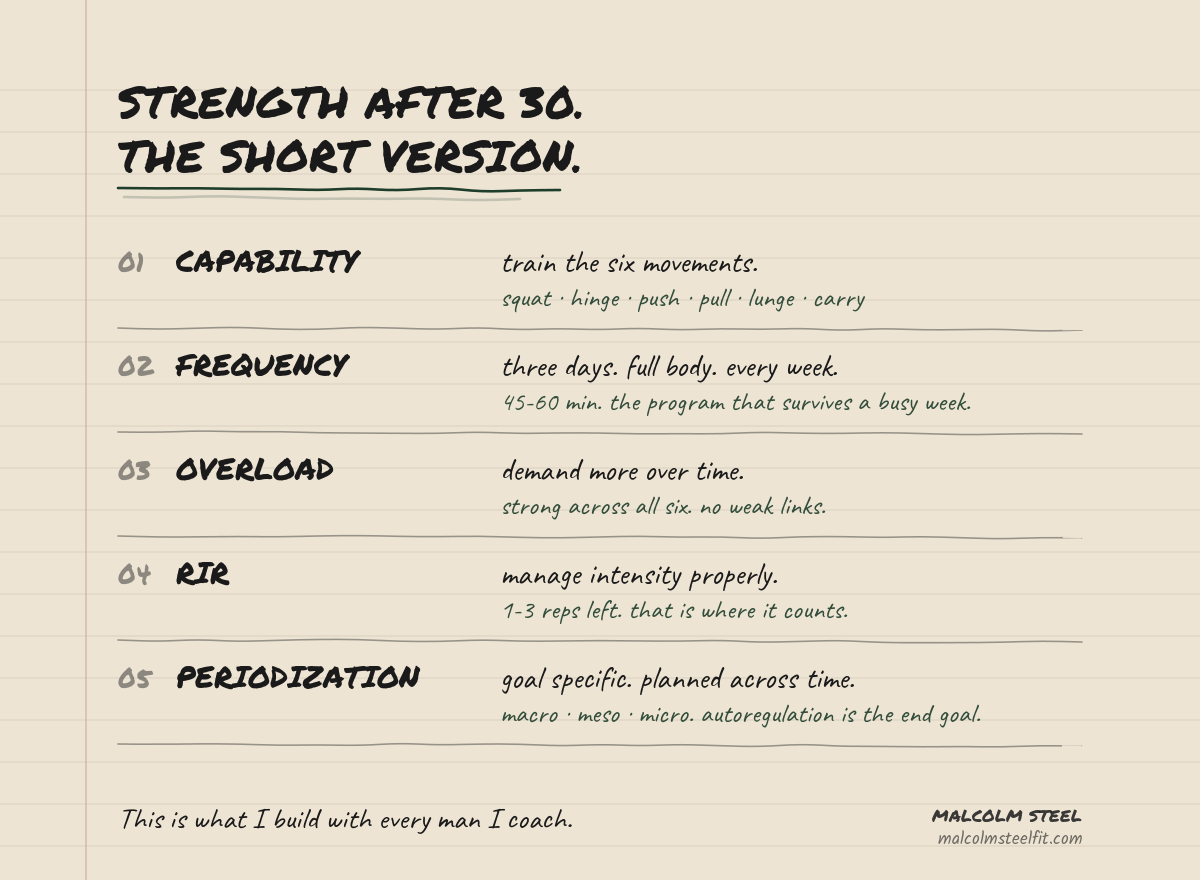
Five foundations. Get these right and the rest is detail. Get them wrong and no program will save you.
1. Capability. Train for the real world, not the mirror.
There is a man in every gym who pulls four plates off the floor and would be useless in a pick up game of just about anything. He is proud of the deadlift. He should be. But he built one number and called it a body, and it will not help him at fifty two, lifting a suitcase overhead after a fourteen hour day.
Train to be strong, well composed and hard to break, and you will look like a man who trains. You will also be able to use it. All show and no go is a bad trade at any age, and a worse one at forty.
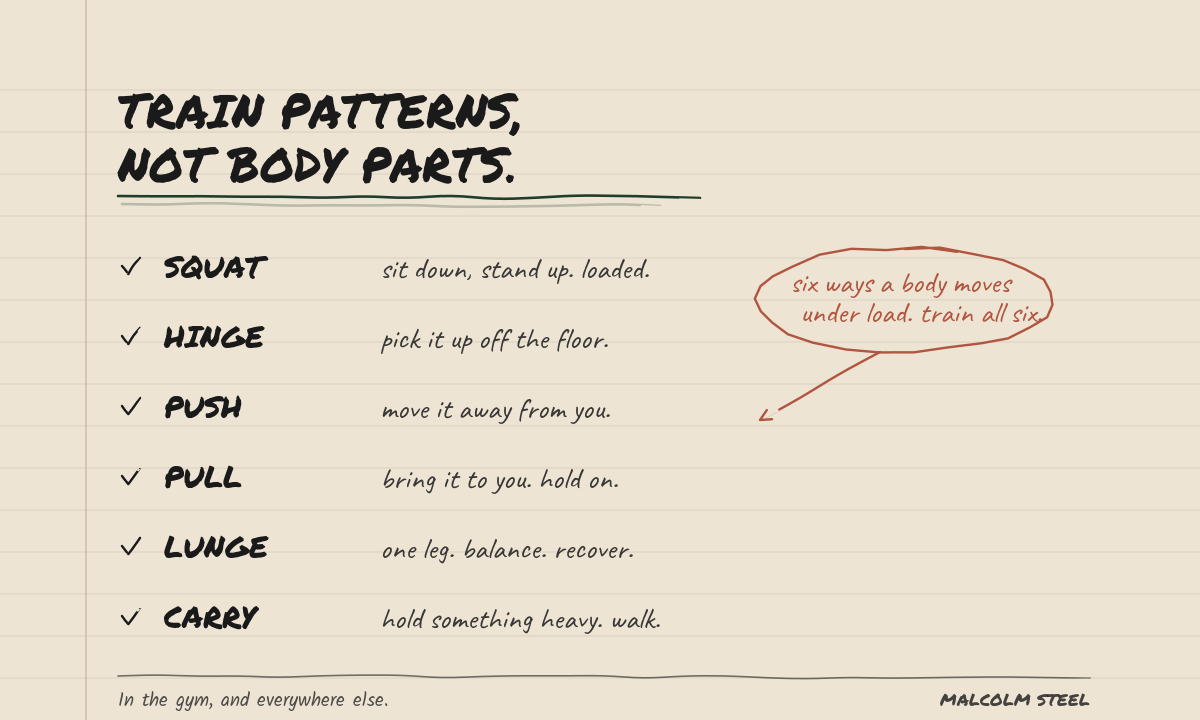
Which is why you train patterns, not body parts. Squat, hinge, push, pull, lunge, carry. Six ways a body moves under load, in the gym and everywhere else. Train the six and you are training for the world, not the mirror.
So change what you measure. Can you carry heavy things without your back filing a complaint. Can you get off the floor, up a mountain, through a long day on your feet. Can you go hard on Saturday and still be useful on Monday.
These are the things you will still want to do long term.
2. Frequency. The program you can hold beats the one you admire.
You have started the six day split before. It went well for three weeks, then a work trip landed, then a sick kid, and by week six you were training twice and calling it a write-off.
That program did not fail because it was badly designed. It failed because it required a life you do not have. Miss one of six and you have lost a body part for the week. Miss one of three and you have still trained everything, twice.
Three sessions a week, full body, forty five to sixty minutes. It survives a travel week, a bad quarter and a newborn. Not the most program you could run. The most program you will still be running in March.
3. Progressive overload. Strong enough, everywhere.
What did you lift on your top set last Tuesday. If you cannot answer that, you are not training. You are exercising.
Adaptation is the response to a demand that exceeds what you have already met. So track your numbers and beat them. Load, reps, sets, every session. Then decide deliberately when you are pushing and when you are holding.
But know what you are climbing toward. The goal is not to be infinitely stronger. Nobody needs a five hundred pound deadlift to live well at fifty. The goal is to be strong enough across all six patterns, with no holes in it. One lift you are proud of and five you avoid is not strength. It is a hobby with a weak point.
Strong enough and well rounded, held for twenty years, beats a heroic number and a wrecked back that sidelines you for a decade. We train in the gym for the life outside it.
4. Reps in reserve. The variable you are getting wrong.
You are not training as hard as you think you are. Almost nobody is.
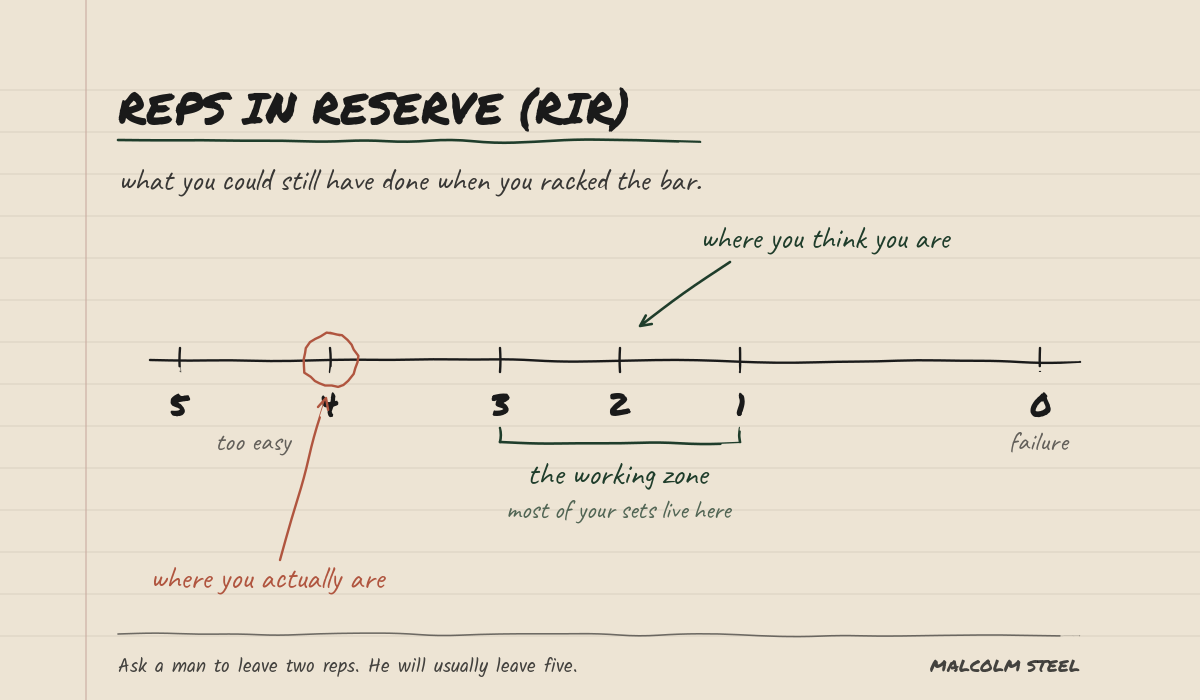
RIR is reps in reserve: what you could still have done when you racked the bar. It is the most overlooked variable in training, and it is what regulates intensity, and therefore results.
Ask a man to leave two and he will usually leave five. His form is clean, the bar is still moving, and he stops anyway, because it has started to feel like work.
Hard sets are the currency. Most of your work belongs between one and three RIR. A set taken to "that was tough" buys very little, and you can do a hundred of them and go nowhere.
5. Periodization. Plan the block, autoregulate the week.
The week you most need to pull back is the week you feel worst about pulling back. That instinct is costing you.
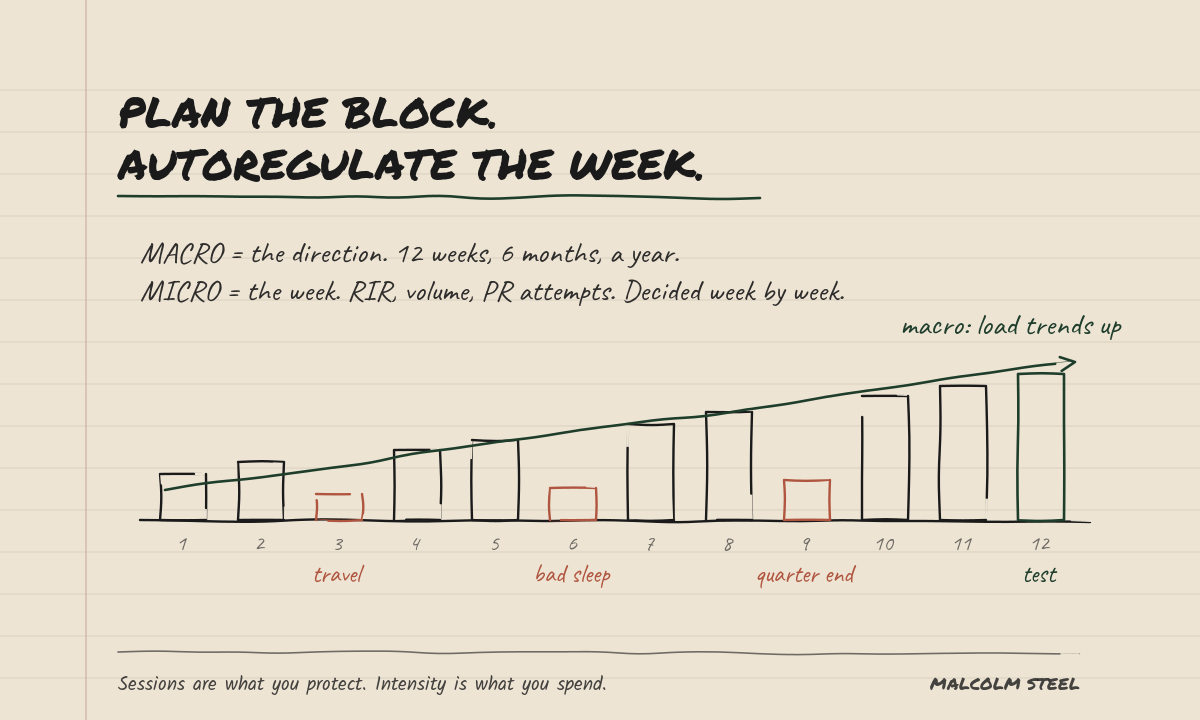
Periodization is planning training across time. Not one block. Twelve weeks, six months, a year, several years, depending on what you are building. The macro is the direction: how load and volume climb, when you test, what this quarter is for. The micro is the week: what actually happens on Tuesday.
A professional athlete can plan a year out because his life is built around the plan. Yours is not. Your Tuesday depends on real life. A social calendar, a terrible night of sleep, prolonged stress around a deal in the pipeline. A coach who hands you a fixed sixteen week document has not built you a system. He has built you a wish.
So the macro holds direction. You are building, the phases progress, the load trends up. The micro flexes. RIR, volume, whether you go for a PR at all, decided week by week against what you are actually carrying.
Because training stress is only one input. Total stress load is the number that matters, and after thirty most of yours is spent outside the gym. Sleep and stress are the two biggest levers you own. Not the cold plunge, not the sauna you post about.
A man sleeping five hours in a brutal quarter is not undertrained. He is under-recovered. Adding intensity and volume to that is not commitment. It is digging the hole deeper.
On those weeks the weight comes down. Lighter loads, fewer sets, same three sessions. Sessions are what you protect. Intensity is what you spend.
What it costs
This is boring. The same six patterns, week after week, with slightly more weight on the bar. No transformation photo at the end, because it never ends. You will train on weeks you do not feel like it, and for long stretches nothing visible will happen.
You are a career athlete now. Your performance is measured in decades, not seasons, and the season does not finish. What matters is not the work you feel like on the good weeks. It is the floor you refuse to drop below on the bad ones.
The strength you build in your thirties is not for your thirties. It is what you stand on at fifty and beyond, when the men around you are managing decline and you are still adding weight.
Train for that man.
Malcolm
———
I coach career athletes: men in their thirties building bodies that perform now and last long term. If you want this built properly, and built around your actual life, here's how I work.